

There is a particular kind of file that only exists in businesses with two locations. It is called something like “Pricing_FINAL_airdrie_copy(2).xlsx,” it lives on a laptop that commutes up the QE2 every morning, and it is almost, but not quite, the same as the version sitting on a shared drive in Calgary. It simply grew, the way mould grows, in the gap between two offices that were never really set up to work as one.
I bring this up because a lot of companies along the Calgary and Airdrie corridor have quietly become hybrid without ever deciding to. Somebody moved north for a bigger yard. Half the staff now drift between the two offices, plus a kitchen table on Fridays. The technology, meanwhile, is still arranged for a single building in a single city. If you are getting quotes for IT services in Airdrie, the first question to put to a provider is not about price. It is whether they have noticed that your company now lives in two places at once.
Table of Contents
The drift is the problem, not the distance
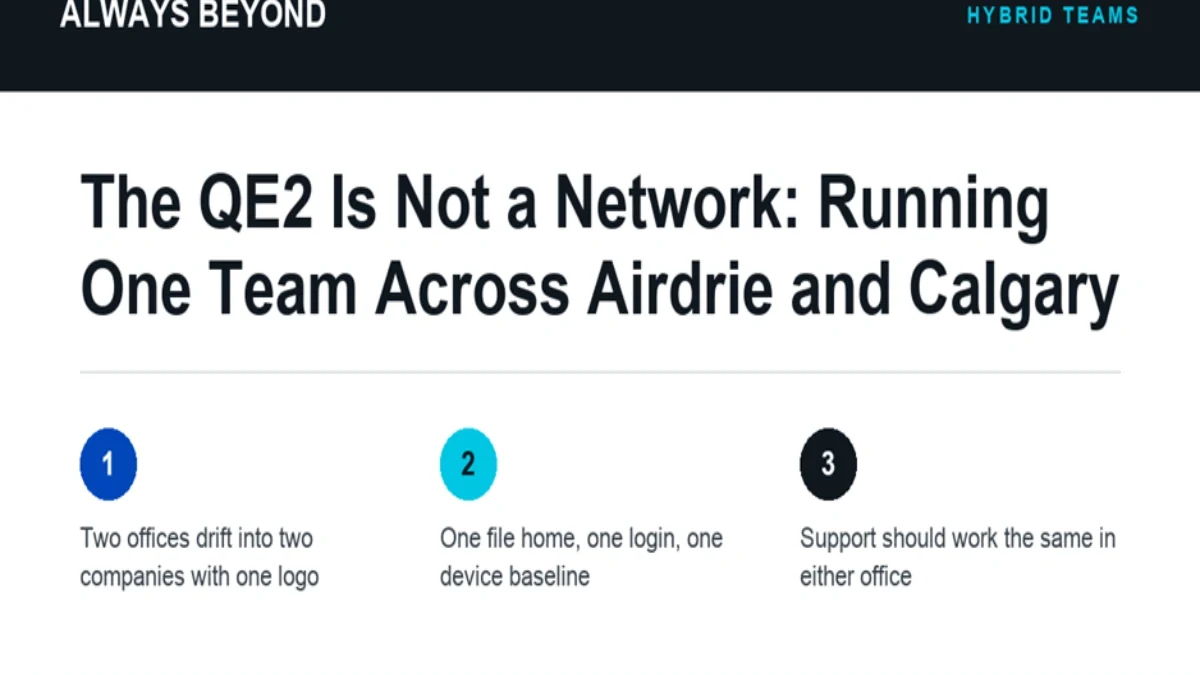
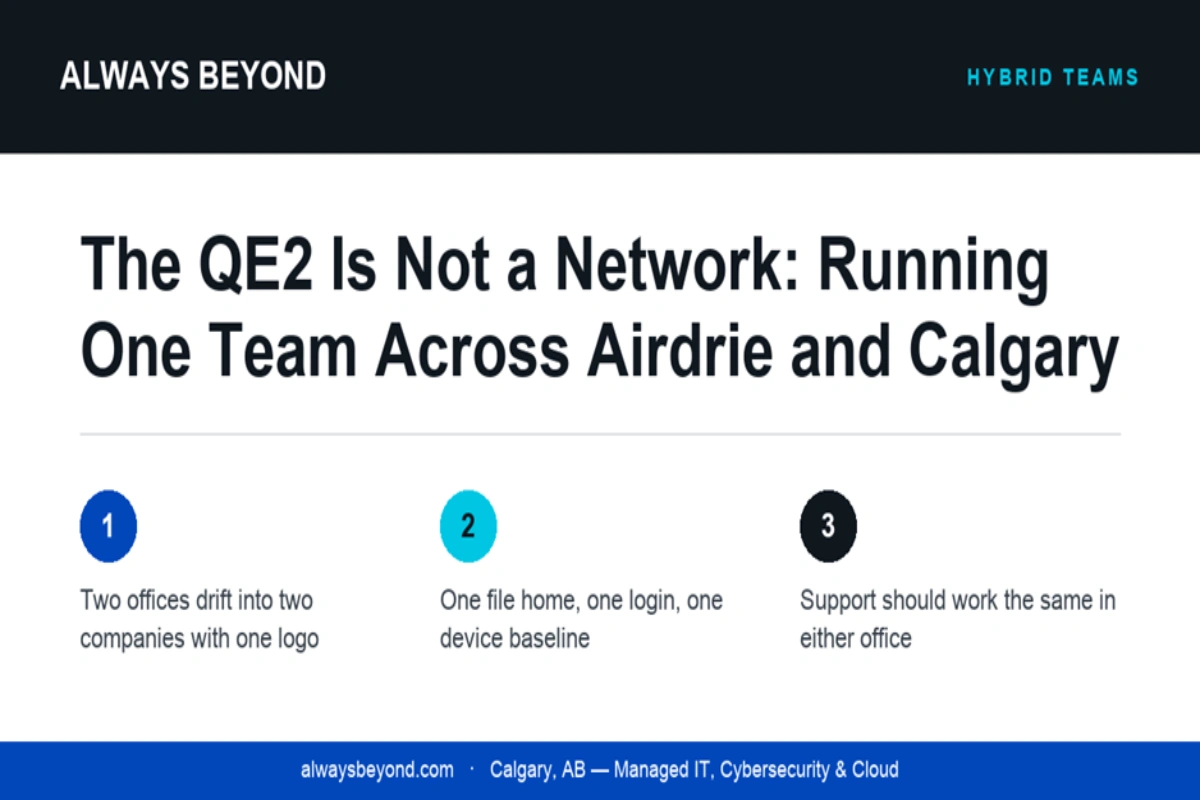
A short stretch of highway is not a technical challenge. What breaks a two-site business is drift: the slow divergence of how each location does things. Airdrie saves to the desktop because the shared drive was slow that one week. Calgary has a different printer setup, a different Wi-Fi password taped to a different wall, and a different person who “knows how the server works.” Each habit makes local sense. Together they produce two companies wearing one logo.
You see it most clearly when someone new joins. The Calgary hire gets a laptop configured by whoever was around; the Airdrie hire gets a hand-me-down and a list of passwords on a sticky note. Six months later they are doing the same job with different access and different folders.
One set of files, one front door
The fix is unglamorous and it starts with files. Pick one home for company documents, in the cloud, organized by team or function rather than by location. Not “the Airdrie folder” and “the Calgary folder,” because that structure just rebuilds the two-companies problem in software.
Access comes next. Every person should sign in with one identity that works the same from the Airdrie office, the Calgary office, and the parking lot of a client site in between. That identity should be protected by strong multi-factor authentication, and it should be the only key anyone needs. When access is tied to a person rather than a building, you stop hearing “I can’t get in from here” as though “here” were a technical setting.
Then the devices. Laptops in both locations should be set up the same way, from the same baseline, with the same security settings and the same software. That sounds bureaucratic until the day someone’s machine dies in Airdrie and the spare in Calgary can be handed over without a weekend of reinstalling things.
Support that doesn’t care which office you’re in
Here is where two-site businesses often get stuck. They have a technician (or a nephew, or a vendor) who is genuinely good, but who is effectively based at one location. The other office learns to wait. Problems there get saved up for “when he’s next in,” which means small issues turn into lost afternoons and people invent their own workarounds. Those workarounds are, of course, where the drift comes from.
Most support today does not require anyone to be in the room. Password resets, permissions, a stubborn email account, a laptop that refuses to update: all of it can be handled remotely, quickly, and identically for both offices. What you want is one way to ask for help, one queue, and one standard of answer, in either office.
The test worth running
If you want to know how consistent your setup really is, try this. Ask someone in each location to find the latest version of an important document, sign in from a personal network, and explain who they would call if their laptop stopped working this afternoon. If you get two different files, one shrug, and a phone number for a person who left last spring, you have your to-do list.
None of this requires a dramatic overhaul. It requires someone to decide that the company is one company, then to arrange the files, the logins, and the support to match. The highway between Airdrie and Calgary will keep doing its job. Your technology should stop treating it like a wall.